
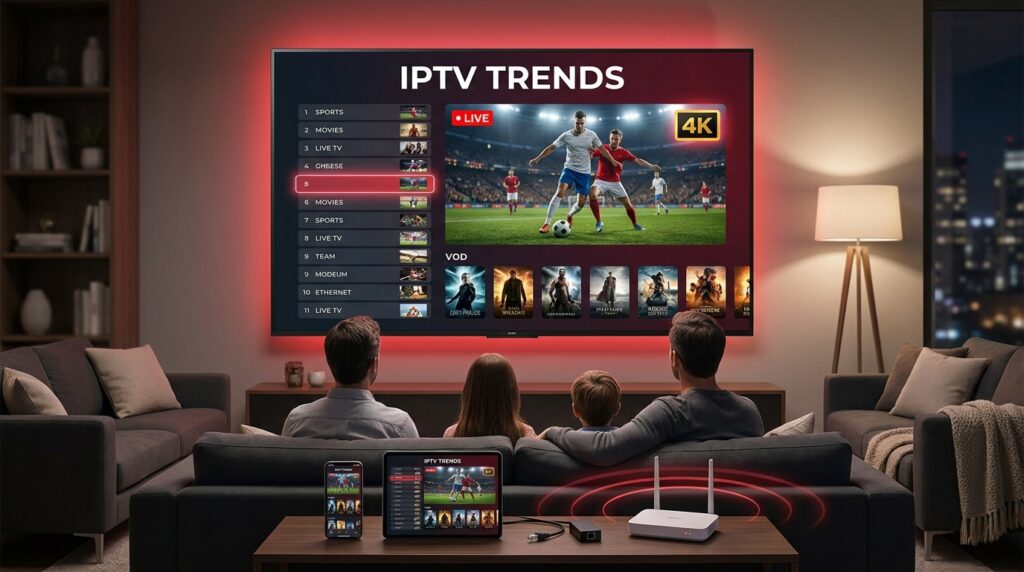
Why Buyer Behaviour Is the Real Story
IPTV stands for Internet Protocol Television. As the Wikipedia entry on Internet Protocol Television explains, it delivers TV over internet networks rather than cable or satellite.
The market did not change on its own. It changed because households stopped falling for the same things:
- Channel counts stopped persuading anyone
- Free-trial demand became a condition rather than a bonus
- Long prepayments lost their appeal
- Peak-hour performance became the deciding factor
Each of those shifts forced a corresponding change in how services are sold. Understanding your own side of the market is more useful than tracking theirs.
Trend One: Connection Counts Replaced Channel Counts
This is the most consequential of the current IPTV trends, and it reflects how households actually watch.
Ten years ago a single household television carried the evening. Now several screens run simultaneously, and buyers noticed which number determines whether that works:
- One person watches sport on the main television
- Another streams a series in a bedroom
- Someone else watches on a tablet entirely separately
- The connection count decides whether all three succeed
A service advertising thirty thousand channels on one connection serves that household worse than one offering four connections and a fraction of the catalogue. Buyers worked this out, which is why connection counts moved to the front of pricing pages. Compare plans openly on the BIEN CAST pricing page.
Trend Two: Test-First Became the Norm
The second shift changed the sales process itself.
Households stopped treating reviews as evidence, for good reason: most are affiliate-driven, and none can know your channels, your peak hours, or your devices.
What replaced them:
- Trials became a requirement, not a courtesy
- Refusing a trial now reads as an answer
- Buyers test during live events rather than quiet afternoons
- Personal evidence outranks any published ranking
This is a genuinely healthy development. A service that lets you verify before paying is making a statement about its own confidence, and buyers learned to read that signal. Test it yourself with the 24 hour BIEN CAST trial.
Trend Three: Shorter Plans, Deliberately
The third shift is about risk rather than price.
Multi-year and lifetime plans once looked like obvious value. Households learned otherwise, usually the hard way:
- Services disappear more often than any marketing admits
- “Lifetime” means the service’s lifetime, not yours
- A long plan concentrates all your risk in one payment
- The monthly saving rarely justifies the exposure
The resulting behaviour is sensible: buy short first, verify over a couple of months, then extend once a provider has proved itself. The small premium on a shorter plan is cheap insurance, and buyers now treat it that way.
Trend Four: Device Consolidation
The fourth shift is quieter but reshapes setups.
Households used to accumulate devices: a stick here, a box there, a smart TV app somewhere else. That fragmented, and now people consolidate:
- One capable device per active screen, rather than several per room
- Modern 4K hardware replacing ageing pre-2020 sticks
- Standard player apps preferred over proprietary ones
- Wired connections for main televisions where possible
The practical benefit is portability. A standard player with standard credentials means switching providers costs nothing but re-entering a login, which strengthens the buyer’s position considerably. Setup steps for each device are on the BIEN CAST setup guide.
What These Trends Mean for Your Choice
Translating the four shifts into a decision:
- Price the connection count you actually need, not the channel total
- Insist on a trial and test during your own peak viewing
- Start with a shorter plan, extending only after it proves itself
- Use a modern device and a standard player app
- Verify your specific channels rather than trusting totals
- Message support before paying and time the reply
Every one of these follows from how households actually changed, which is a better guide than any prediction about the technology.
The Wider Market Context
These household shifts sit inside a larger movement. Research from Statista on the streaming market documents internet-delivered video growing every year while traditional pay TV keeps shrinking.
The pressure driving it is simple:
- Cable bills kept rising while catalogues stayed regional
- Licensed streaming fragmented into many separate subscriptions
- Household streaming costs crept upward as a result
- Consolidation into one service became the obvious appeal
The underlying demand is not technological. It is households tired of paying several bills for what one used to cover.
What Should IPTV Cost in 2026?
Buyer pressure pushed pricing into a recognisable band.
Realistic pricing by plan length:
- 6 months: roughly $40, a reasonable starting commitment
- 12 months: around $60, commonly the strongest value at about $5 monthly
- 24 months: around $100, lower per month with more exposure
- 36 months: around $135, the cheapest monthly rate
A price far below that band is not a trend, it is a warning. Server capacity that survives peak hours costs money regardless of marketing.
What Internet Speed Do Current Habits Require?
Multi-screen viewing raised the baseline. According to the FCC Broadband Speed Guide:
- SD quality: 5 Mbps
- HD and FHD: 10 Mbps
- 4K Ultra HD: 25 Mbps per stream
Applied to modern households running three or four screens, 75 to 100 Mbps is the practical target, noticeably higher than guidance from a few years ago.
Run a free test at Speedtest.net before blaming any service. A weak connection and a weak service look identical on screen.
Simple fixes for buffering
- Use wired Ethernet for your main TV
- Keep the router close to your streaming device
- Pause large downloads during peak hours
- Restart your router weekly
IPTV vs Cable in the Current Market
| Feature | IPTV in 2026 | Traditional Cable |
|---|---|---|
| Monthly cost | $4 to $15 | $100 to $150 |
| Extra screens | Connection count | Another rented box |
| Testing before buying | Trial expected | Not offered |
| Commitment | Prepaid, short options | 12 to 24 months |
| Switching | New credentials | Return equipment |
| Setup | 2 minutes, self-serve | Technician appointment |
Cable never adapted to any of the four household shifts, which explains a great deal about the migration.
Are Current IPTV Trends Legal?
An honest answer matters here. The technology is entirely legal, and paying for a subscription is legal. What determines legality is whether a provider licenses the content it streams.
When a seller offers premium channels for almost nothing, that raises questions, because real licensing is expensive. Streaming unlicensed content is illegal in the United States and most countries. The U.S. Copyright Office publishes clear information on content rights.
Choose providers that are transparent about their terms, publish real pricing, and accept standard payment methods.
Red Flags That No Trend Removed
Some warning signs never changed:
- No trial offered, which buyers now treat as disqualifying
- Hidden pricing requiring contact for a quote
- Prices that defy operating economics
- Connection count unstated, hiding the number that matters
- Crypto-only checkout removing your recourse
- No verifiable brand behind the service
Common questions on terms are answered on the BIEN CAST FAQ page, and broader protection is covered by the FTC’s guidance on avoiding online scams.
Applying the Trends in One Evening
Turning awareness into a decision:
- Count your screens and price the right connection number.
- Start a trial and test during your household’s busiest window.
- Search your channels by name on the BIEN CAST channels list.
- Check your device generation before judging quality.
- Choose a shorter plan for a first purchase.
- Message support and time the reply.
If anything is unclear, our team answers on WhatsApp daily.
Frequently Asked Questions About IPTV Trends
What are the main IPTV trends in 2026?
On the household side: connection counts replacing channel counts, testing before buying, shorter plans, and consolidating onto fewer modern devices.
Why do connection counts matter more now?
Because households run several screens at once. A large channel catalogue on one connection serves a family worse than fewer channels across four.
Are long IPTV plans still worth buying?
Buyers increasingly say no for a first purchase. Start short, verify over a couple of months, then extend once a provider proves itself.
Do reviews still help when choosing IPTV?
Less than they did. A review cannot know your channels, peak hours, or devices. A trial generates evidence specific to your household.
Do I need a VPN given current trends?
No, services work without one. Some users add a VPN purely for personal privacy preferences.
Final Thoughts: The Trends That Matter Are Yours
The useful IPTV trends are not predictions about codecs or resolutions. They are the four things households changed: prioritising connections, testing before paying, committing shorter, and consolidating devices.
Each one moves power toward the buyer, and each one is available to you tonight. Count your screens, demand a trial, start short, and use hardware that can keep up. Those habits will still be right long after this year’s marketing vocabulary has changed again.
Ready to buy the way households now do? Start your 24 hour BIEN CAST trial and test during your own peak window, full access, zero risk. Questions first? Message our team and time the reply yourself. And if this guide helped, share it with someone still shopping by channel count.